Shrine Culture: The Sufi face of Lahore

A woman lighting up a chiraagh — a ritual mostly seen at Sufi shrines in the subcontinent.

From Daily Pakistan by Shahbano Shahbaz

Sufism, defined as the mystical system of the Sufis, is no less than a divine culture weaved into the history of Pakistan. The practice of Sufi customs within the subcontinent is a spiritual and complex discourse itself with not only an extraordinary timeline of tales, it also leads to the establishment of shrines culture. With an evolution of over 1000 years this sacred practice left its mark in the form a spiritual culture that promotes love, tolerance and inclusiveness. Continue reading

Posted in News, Religious Observance - Islam | Comments Off on Shrine Culture: The Sufi face of Lahore

Sept 8, 2017/17 Dhul Hijjah 1439 Khutba – Differences

bismillah-circleA’udhu Billahi min ash-shaitan ir-rajeem

Bismillah Ar-Rahman Ar-Rahim

Ash-hadua la ilaha il allah, wah-dahu la Sharik allah; Wa Ash-shahadu anna Muhammadan ‘Abduhu wa Rasoollahu wa’al Mustafa 

I seek refuge in Allah from Shaitan, the rejected

In the Name of Allah, the Most Merciful,the Most Compassionate.

I bear witness that there is nothing to be worshiped except Allah, One without any Partner or Associate. And I bear witness that Muhammad is His Servant and His Messenger, Chosen by Allah.

Al hamdu Lillahi Rabbil ‘Alameen. Ahmaduhu Subhanahu wa T’ala wa Ash-kuruhu wa Huwa Ah-lulhamdi wa th-thana

Al hamdu Lillahil-Lathi Anzala ala ‘Abdihil-Kitaba wa lam ya jal-Lahu ‘Iwaja

All praise belongs to Allah, the Guardian, Protector, Sustainer of all the worlds. I Praise Him, the Exalted, the Most High, and thank Him; and it is He Who deserves all Praise and Thanks
Continue reading

Posted in Khutbas | Leave a comment

‘Sufi poetry a glorious chapter of Kashmiri literature’

Sufi poetry has played a ‘very important role’ in reflecting the pain and sufferings of people in Kashmir for a long time and its distinct way of communicating the expression has no parallel.A galaxy of scholars, writers and poets stated this at a function organised by Adbee Markaz Kamraz Jammu and Kashmir at Chakpora, Pohroo, on the outskirts of Srinagar city on Saturday.The function was organised in collaboration with Jammu and Kashmir Academy of Art, Culture and Languages (JKAACL)  to release the poetic collections—Noor-i-Wahdat and Gaebi Nida of a Sufi poet Ghulam Nabi Dar.

AMK president Dr Syed Shujaat Bukhari presided over the function while Secretary Academy Dr Aziz Hajini was the chief guest. Noted poet Zareef Ahmed Zareef and Islamic scholar Qazi Ghulam Nabi Noorani read out papers,critically analysing the books.
Noted writer and poet Rafiq Raaztalked about the Sufi poetry and its different aspects. He said it was a different way of poetry to “give words to suffering, pain and a thought process”.

“It is unique, and we generally connect it with religion,” he said, adding that Sufi poets have made a huge contribution in this regard.
Noted writer and critic Prof Farooq Fayaz called Sufism the ‘spiritual part of Islam’ and said those who take recourse to poetry are ‘in a way expressing spiritualism and that also brings in a unique expression’.

“When there is a conflict between the state and the society, the value system gets a beating and in that situation Sufism comes in picture,” he said.
Fayaz said Sufi poetry was responsible for keeping the Kashmiri language alive.
The former head of the Kashmir University’s Department of Kashmiri, Prof Shad Ramzan, deciphered what Sufism and Sufi poetry meant.

In his remarks, Dr Hajini said it was the time for all Kashmiris to introspect about the fate of the Kashmiri language. “If we look back, this (Sufi poetry) is the real treasure that we have in our literature as they (Sufi poets) connected the people with the language,” he said.
He said poets such as Shamas Faqir and Ahad Zargar were those ‘who struck a chord with reality and were selfless people who would not write for awards’.
Stating that the Sufi poets had hugely contributed in promoting and preserving the language, Dr Shujaat Bukhari said today’s Kashmir was facing many challenges, including a ‘cultural invasion’.

Unfortunately,he said, Sufism was being ‘exploited by certain quarters to bring peace’, but in essence,‘it was being done to put one another at loggerheads’.
He said AMK was committed to work for the preservation of the language.
Sufi Poet GN Dar also spoke on the occasion. AMK General Secretary, Mohammad Amin, conducted the proceedings. Folk singer, Ghulam Ahmed Sofi, mesmerised the audience with Sufi poets’ verses. Members of the Jammu and Kashmir Saqafati Markaz, Budgam, Dr Shabnum Rafiq, Mehboob Nowgami, Hasrat Hameed were among many others present on the occasion.

Source: ‘Sufi poetry a glorious chapter of Kashmiri literature’

Posted in News | Leave a comment

BBC – A beginner’s guide to Qawwali music

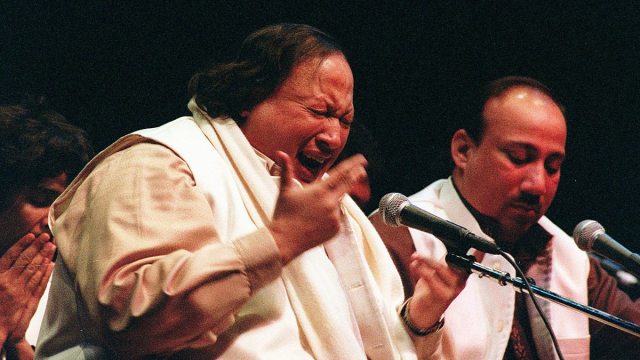
Nusrat Fateh Ali Khan is widely credited for bringing global attention to Qawwali music, extending the 600yr old Qawwali tradition of his family. By the time of his death following a heart attack, aged 48, in London, Nusrat was a legend in the artform.

The Asian Network is marking the anniversary of the death of Nusrat Fateh Ali Khan

This month sees the 20 year anniversary of his passing and we’re celebrating his work, and Qawwali music, on the Asian Network. But if you’re not quite up to speed with this potentially euphoric musical tradition, we’ve got a beginner’s guide to get you started.

What is Qawwali?

“Qawaali music,” explains Bobby Friction, “Is the physical and musical manifestation of the Sufi religious tradition in South Asia. Powerful, poetic & transcendent, its hypnotic rhythms and melodies celebrate God, love and music as one.

Qawaali emerged in what is now India and Pakistan in the 13th century, in close association with the Sufi and their Islamic mysticism. Typically, there are a lot of people involved in a performance, with eight or nine players making music with harmoniums, tabla, dholak and other percussive instruments. There was a time when women were banned from performing Qawwali music, but things have changed.

A lead vocalist and a small team of side singers take turns weaving in several different melodies, some of which will be improvised. After a long, improvised introduction for the main song, the singers all join in and vie with each other as the song builds towards its crescendo and sudden, abrupt end.

It’s all about the build-up, so Qawwali songs are rarely short – there are no radio edits here. They can be anywhere between 15 and 30 minutes long, with one of the longest known Qawwali songs – Hashr Ke Roz Yeh Poochhunga by Aziz Mian Qawwal – being almost two hours long!

What are the religious roots of Qawwali?

Qawwali has a deeply religious history dating right back to the 13th century. It is the music of Sufi-sm, also known as ‘Islamic mysticism,’ whose followers believe in learning from teachers, rather than relying on texts. The influence of Sufism is huge within Islamic literature, music and the wider artistic beyond Qawwali music was originally performed at Sufi shrines, and traditionally as part of a ‘mehfil-e sama’, a gathering for spiritual listening which often takes place on the anniversary of the death of shrine’s saint. It is still very religious music today.

What happens when people listen to Qawwali?

If you’re at a Qawwali performance, you could be in for quite the experience,

Qawwali music is performed with the intention of bringing listeners to a state of religious ecstasy and is known to hypnotize both performers and listeners.

The reaction to Qawwali is intended to bring everyone involved to a spiritual union with God. If you get the chance to see a performance it can be an intense and profoundly moving experience, no matter your personal faith.

How has Qawwali evolved over the centuries?

Qawwali music has moved with the times. Women are now welcomed both to perform and watch it, which they weren’t for a very long time.

It has also become really popular all over the world. Qawwali music was only really known in South Asia until the late 20th century, but after world music artists began working elements of Qawwali into their work, things went global.

Nusrat Fateh Ali Khan appeared on Peter Gabriel’s The Last Temptation of Christ soundtrack in 1988, and released six albums on Real World records. He recorded hundreds more (although some were never released commercially) during his career.

Qawwali musicians were given exposure in the UK with performances at WOMAD festival and supported by Peter Gabriel’s record label, Real World, during the early nineties.

Who are the important names in Qawwali you need to know?

OK, so Nusrat Fateh Ali Khan is a hugely important Qawwali musician, but who else should we be listening to?

The Sabri Brothers are also a leading force in the Qawwali music industry. They performed together for 60 years, between 1956 and 2016, released 53 albums during their career and their music is definitely worth checking out.

And it’s not just India that has produced the big names of Qawwali, Pakistan has a history of stars as well. Amjad Farid Sabri was one of the biggest Qawwali musicians from Pakistan and became one of the genre’s most acclaimed stars. Sadly, he was shot dead in Karachi by militants.

Nusrat Fateh Ali Khan’s legacy has been continued by his nephew Rahat Fateh Ali Khan, who is currently one of the biggest names in Qawwali music. He was trained by his uncle from the age of seven and has contributed music to many Bollywood and Hollywood movies during his career. He even worked as a judge on TV talent show Chhote Ustaad in India.

The Nooran Sisters (Jyoti and Sultana) are two of the best known female stars of the genre. They came to fame on MTV India’s talent show Sound Trippin and have sung in a string of Bollywood films.

Source: BBC – A beginner’s guide to Qawwali music

Posted in News | Comments Off on BBC – A beginner’s guide to Qawwali music

Khutba 2017 08 18 – Zikr of the Heart

bismillah-circle

The text of the khutba is available as a PDF file. Please go to zikr of the heart to download the file.

Posted in Khutbas | Leave a comment