Discostan’s Founder Followed Her Love of Sufi Spiritual Music All the Way to Pakistan

Arshida Fatima Haq records the alghoza player Jai Raam in Pakistan

Arshia Fatima Faq’s album of field recordings, “Ishq Ke Maare: Sufi Songs From Sindh and Punjab, Pakistan,” captures a style of music the Taliban is trying to wipe out.


Source: Discostan’s Founder Followed Her Love of Sufi Spiritual Music All the Way to Pakistan

Posted in News | Comments Off on Discostan’s Founder Followed Her Love of Sufi Spiritual Music All the Way to Pakistan

Sufism provides platform for interaction between East, West

With Muslims being portrayed as terrorists in the West, giving rise to Islamophobia, drawing a corresponding response from the East, Sufism provides a platform for the two sides to interact.

This was stated by Marcia Hermensen, a professor at the Loyola University in Chicago while delivering a lecture on “Sufism and the West”. The lecture had been organized by the Muslim Institute.

Exploring the mysticism of Sindh’s Sufis

Hermensen said that Sufism, practiced for centuries, made co-existence among various religions and civilizations possible in the past.

Moreover, she said that Sufism was often characterized as culture-friendly so that Islamic thought could be introduced through subjects such as art and poetry and hence Islam could spread around the world by meeting people where they were in their cultural interest in an adaptive manner.

In the wake of globalization, migration from ‘East’ to ‘West’ increased along with the invention of different modes of transportation, allowing more and more western population to come into contact with Sufism and also led to the establishment of Sufism in the West as an academic field. “The isolation of individuals has lead people to search for inner peace in Sufi poetry which can thus create a peace-loving and friendly society. Sufism provides the western community with rationality and objectivity regarding contemporary issues,” Hermensen said.

“Multiculturalism has emerged as a reality and Sufism provides us with the platform of interaction between the East and the West.”

One peculiarity of Sufi teachings, she said, was that it addresses humanity above all linguistic, racial and ethnic differences.

Celebrating Sufism and promoting the message of peace

“In the wake of prevailing extreme tendencies, Sufi teachings can lead us towards harmony and brotherhood,” she said, adding that focusing the commonalities and bridging the gap between people was the need of the hour.

With the portrayal of Muslims as extremists in the west giving rise to Islamophobia, drawing corresponding reactions in the East. there was a need for dialogue between Muslims and the West for the resolution of contemporary issues. “We are all connected to Sufism because of our spiritual aspect. Even scientists are looking for spiritual connections behind physical happenings,” she said.

Published in The Express Tribune, July 19th, 2017.


Source: Sufism provides platform for interaction between East, West

Posted in News | Comments Off on Sufism provides platform for interaction between East, West

Sufi shrines in China

New York-based artist visits enduring symbols of collective memory and faith in desert environment in northwest China

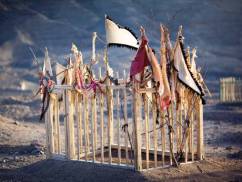
Photographer Lisa Ross is interested in exploring the liminal spaces where faith, culture and abstraction meet. In her latest exhibition in Dubai, Living Shrines, she is presenting a series of photographs of Sufi shrines in the Taklamakan desert in China, built by Uighur Muslim pilgrims. Between 2002 and 2012, the New York-based artist made several trips to the remote Xinjiang Uighur Autonomous Province in the far northwest of China to document these shrines that stand as poignant and enduring symbols of collective memory and faith in the harsh desert environment.

The shrines, known as mazars were built by the Uyghur people to commemorate Sufi saints, and many have been maintained continuously for several centuries. They are simple structures, comprising small crib-like wooden enclosures, or just a few sticks and stones arranged in the sand. But their importance in Uighur culture is indicated by the many offerings left behind by pilgrims, such as prayer flags, colourful silk fabrics, sacrificial animals, and dolls.

Ross’s ethereal photographs capture the beauty and tranquility of the desert landscape, and the simplicity and spirituality of the shrines. The tiny handmade structures appear so vulnerable, yet resilient; grounded yet otherworldly; ordinary yet extraordinarily beautiful.

There are no people in the pictures, but their presence is palpable in the fluttering flags, the carefully cut pieces of fabric, and other offerings they have left behind, and their footprints in the sand. The images convey Ross’s intimate knowledge of the culture, and her love for the land and people, but they also go beyond that to give viewers a sense of experiencing the pilgrimage, and the spiritual transcendence it signifies.

“I began this project at a time when I was really drawn to deserts. I had been working in the Sahara and Sinai deserts before a friend invited me to Beijing. I had never heard of the Uighurs or the Taklamakan desert, but when I read about the Xinjiang Uighur Autonomous Province in a travel guide in Beijing, I intuitively felt like going to this remote region. It involved a train journey of three and a half days, and then finding a rental car and a driver to take me deeper into the desert.

“When I saw these shrines for the first time, in the rugged, desolate desert I had no idea what they were. I was curious to learn more about them,” Ross says.

Over the next decade, she travelled to the area many times – on her own, as well as with people who know the region such as French historian Alexandre Papas and Uighur folklorist Rahile Dawut, who helped her to connect with the community and get a deeper understanding of the land and its history. In 2013, Ross published a book, Living Shrines of Uyghur China, which features her photographs of the mazars, and background texts by Papas and Dawut.

“When I travelled with Papas in 2004, we found a pilgrim’s guide book in the Uighur language giving information about the location and history of 86 mazars. Using this guide, we visited over 25 mazars, travelling by foot, donkey cart, bicycle, minivan, taxi, train and bus.

“The people we met were always friendly and helpful, and each journey was a unique pilgrimage. Later, I met Dawut, the author of that guide, at a conference on Uighur culture at the School of Oriental and African studies in London, and she was amazed that her book had been used by two foreigners. She invited me to travel across the region again with her, and in 2005, we travelled together in the area for six weeks. Being with her was like moving from the outside to the inside. Even though we visited remote mazars, she had family and friends everywhere, who welcomed us warmly. The entire experience created a greater desire to return and continue developing the project,” Ross says.

Her photographs become more significant in the context of the changes that are taking place in the region. With the development and modernisation policies of the Chinese government threatening to turn these living shrines into relics of the past, Ross’s images are an important record of a rich and vibrant culture on the threshold of change.

“While working on this project, I made a conscious decision to remain apolitical. Through my photographs I want to convey my personal experience of this region and culture, and also give viewers the same moving, emotional experience that I had when I saw the shrines,” Ross says.

Jyoti Kalsi is an arts enthusiast based in Dubai

Living Shrines will run at Gulf Photo Plus, Al Serkal Avenue, Al Quoz until September 2.

Source: Sufi shrines in China

Posted in News | Leave a comment

Devotees throng Kalaburagi to witness 613th Urs-e-Sharief

Kalaburagi is also known as Gulbargah and is near Hyderabad, India.

Thousands of devotees cutting across religious lines thronged the streets of historic city to participate in the famous sandal procession to mark the beginning of the four-day 613th Urs-e-Sharief of the 14th century Sufi saint Hazrath Khwaja Bande Nawaz Gesudiraz on Tuesday.
Prior to the ceremonial procession from the Mehboob Gulshan Public Garden, devout Muslims participated in a special namaz presided over by the Sajjada Nasheen of the Dargah Sharief, Syed Shah Khusro Hussaini.

Devotees from all over the country and abroad participated in the special prayers and the procession.
The sandal procession was preceded by special prayers since morning, including Khidmat-e-Farrashi and Band Sama at the Dargah Sharief, followed by an address by the Sajjada Nasheen and the special prayers Namaaz-e-Juma.

The procession carrying the sandal paste stopped at the Mehdus Masjid in the Super Market area to offer Namaz-e-Maghrib before reaching the Dargah Sharief, where the sandal procession was received at the Gyarah Sidi (Eleven steps) leading to the Dargah Sharief.

Source: Devotees throng Kalaburagi to witness 613th Urs-e-Sharief

Posted in News, Sufi Urs and Event Dates | Leave a comment

Sufi Music enthrals audience at RAC – PakObserver

Rawalpindi

Sufi Music enthralled a large number of people who gathered for Independence Day celebrations under auspices of Rawalpindi Arts Council. The main performers of the Sufi Musical Night were Qurban Niazi (TI), Ghulam Abbas Farasat, Maria Kanwal and Aqdas Hashmi while Masud Khawaja amused the participants as anchor person.

Ghulam Abbas Farasat from Lahore opened the night with mili song with his own poetry and composition. Maria Kanwal a blind singer impressed the audience with her singing and received thunder appreciation. Aqdas Hashmi presented traditional qawwali with his own style. The main sufi and folk singer was Qurban Niazi (Tamgha-e-Imtiaz). With traditional dress and folk musical instruments enchanted the atmosphere. The singer through his singing delivered valuable message of sufi saints and mystics. The folk vocalist lent his melodies to add exciting colors to sufi musical night.
MPA Raja Hanif Advocate, MPA Lubna Rehan Pizada, Naheed Manzoor and Resident Director RAC Waqar Ahmed appreciated the performance of the vocalists while Tariq Mehmood Tariq Additional Commissioner, Aqeel Ahmed Additional Commissioner (Revenue), Ehsan Ozurik Country Head IHH attended the event.

Source: Sufi Music enthrals audience at RAC – PakObserver

Posted in News | Comments Off on Sufi Music enthrals audience at RAC – PakObserver