
As Allah (swt) says in the Quran Sharif in Sura Ar-Ra’d:
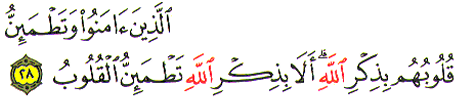
‘alladhena ‘aamano wa- tat.ma’inn qulob -hum bi- dhikr ‘allaah . ‘a-laa bi- dhikr ‘allaah
tat.ma’inn al- qulub
“Those who believe and whose hearts find satisfaction in the remembrance of Allah: for
without doubt in the remembrance of Allah do hearts find satisfaction“
And in a hadith reported by Muslim sahih hadith and narrated by Uqbar ibn Amir:
“We were entrusted with the task of tending the camels. During my turn, when I came back in
the evening after grazing them in the pastures, I found Allah’s Apostle (peace be upon him)
standing and addressing the people. I heard these words of his: If any Muslim performs
ablution well, then stands and prays two rak’ahs thinking about them with his heart as well as
his face, Paradise will be guaranteed for him.”
And in an other hadith Abdullah Ibn Abbas reports that
“He (saw) saw (Allah (swt) with his heart”
The heart (the core of our personality) is the storage place for knowledge and wisdom, and it can
guide us along the path towards God’s pleasure.
The heart however can be afflicted by disease that causes it to be preoccupied by the love of life and
lust rather than the love of Allah. Each and every one of us needs to inspect his heart carefully to
diagnose any affliction, and search for cures.
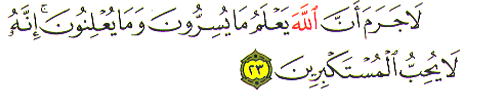
laa jaram ‘anna ‘allaah ya3lam maa yusirrun wa- maa yu3linun ‘inna -hu laa yuh.ibb al-
mustakbirin
Undoubtedly Allah does know what they conceal and what they reveal: truly He loves not the
arrogant.
And arrogance is but only one of these diseases that afflict the heart.
To clear our hearts of any afflictions we need two things:
l. Ask for God’s guidance – In Surah Al Fatiha we pray, “Ihdi nas siraat al-mustaqeem,” “show us
the straight path”. If we have sincerity in this request it is the key to God’s acceptance. Remember
the hadith I spoke of just now “thinking about them with his heart” these are for us to heed it is a
great blessing from Allah (swt)
2.Exert the effort to identify the ailments (the diagnosis) and the effort to avoid the deeds and sins
that fill the heart with impurities (the curse).
For it is narrated by An Numan bin Bashir that the prophet (saw) said:
“Beware! There is a piece of flesh in the body if it becomes good (reformed) the whole body
becomes good but if it gets spoilt the whole body gets spoilt and that is the heart.“
Amongst these ailments that spoil the heart are: Anger (rage), Envy, Stinginess, Ostentation, Love of
Jaah (position and power), Arrogance
To understand a deed we have to understand the role of intention:
Umur bi mukhasibiha
Actions are known by their intentions or “intentions determine the worth of a person’s deeds”
Intentions reside in the heart and Intentions are the sole determinant of the worth of one’s deeds –
the same act can be judged as a sin or a good deed depending on intention. Examples are:
attempted murder – taking a shot and missing
man decides on adultery – before leaving his house he repents and refrains: [Hasana]
Bukhari and Muslim “He who is inclined towards an evil deed but does not carry it out is rewarded by
Allah for one full measure of good deed.”
The same man just about to commit adultery but is interrupted from doing so. – His does not actually
commit the sin, as he was prevented from doing so, by an external factor, not out of any fear of Allلh.
Therefore he has still earned himself a sin, as if he had actually completed his sinful deed.
Anger/Rage – A minimum level of anger should exist to protect oneself and belongings, this anger
should however be tempered.
A modest level of anger is acceptable in matters related to religion.
To succeed in moderating anger one should always be reminded of two points:
1-Train yourself not to get too attached to worldly possessions and keep your necessities to a
minimum.
2- Remember that Allah is the boss. i.e. his will dominates. E.g. if you wanted a certain job, but was
not successful, remember that this is God’s will and there must be a good reason for that, though it
might not be obvious to you at the time, in any time frame, we only see a small part of a bigger
picture.
3- On a physical level you could help moderate this anger by following the prophet’s advice (pbuh)
(as narrated in Al Tirmithi & Al Bukhari:
If one feels anger becoming him he/she should:
If standing – sit down
If sitting – lie down
If lying – make abolution or have a shower
When anger afflicts a person, he/she tend to move forward – by assessing this motion you curb the
anger.
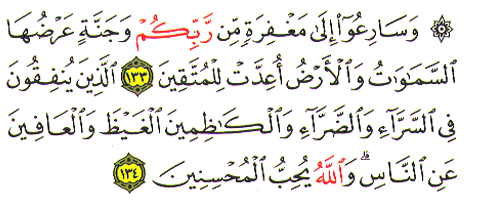
133: wa- saari3u ‘ilaa maghfirah min rabbkum wa- jannah 3ard-haa as- samaawaat wa- al- ‘ard.
U3-iddat li- al- muttaqin
134: ‘alladhena yunfiqun fi as- sarraa’ wa- ad.- d.arraa’ wa- al- kaaz.imin al- ghayz. wa- al-
3aafin 3an an- naas wa- ‘allaah yuh.ibb al- muh.sinin
Al Imran verses 133-134: “Be quick in the race for forgiveness from your Lord and for a
garden whose width is that of the heavens and the earth prepared for the righteous. Those
who spend freely in prosperity or in adversity Who restrain anger and pardon all men. For
God loves those who do good.”
Said Ali Ibn Abu Talib asked a slave for warm water to wash his hands. The girl who was young and
inexperienced poured boiling water onto his hands which burnt them. He got very angry and was
about to strike her when she reminded him of this aya and said:
Those who restrain anger – I have restrained my anger
And pardon men – I have pardoned you
For God loves them who do good – go; I have granted you your freedom.
The prophet (pbuh) said: “One who, in spite of having the ability to avenge, controls his anger, will be
singled out, and called by Allah, the Holy, the Exalted, over and above the multitude on the Day of
Judgement” (Al-Boukhari)
A man asked the prophet for advice. He said “Do not be overpowered by anger”, the man repeated
that three times and the prophet’s answer was the same three times (Al Boukhari)
Omar Ibn El Khatab’s story with a drunk man he was punishing – punishment for Allah’s sake – not
for retaliation.
Ali Ibn Abu Taleb – in a Ghazwa (War) about to kill an enemy who spat at him – restrained himself.
The story of Abu Baker who was being insulted by a man – kept quiet until he could no longer take it
and answered back. At that point the prophet (pbuh) left and when asked why he said: “When you were silent the angels answered on your behalf, but when you started answering the angels left and Satan came and I could not sit in the same place as Satan.“
Islam does not advocate turning the other cheek, but it strongly advocates the control of tempers and
the cleansing of anger.
I leave you with the following advice:
– Always look into your heart and inspect your real intention before performing an act.
– May God help us restrain our anger and pardon people.
– May God help us do good and be charitable.
– May God help us forgive and overlook
And allah knows best

 Ihsan Center - Islam From The Heart