BBC – A beginner’s guide to Qawwali music

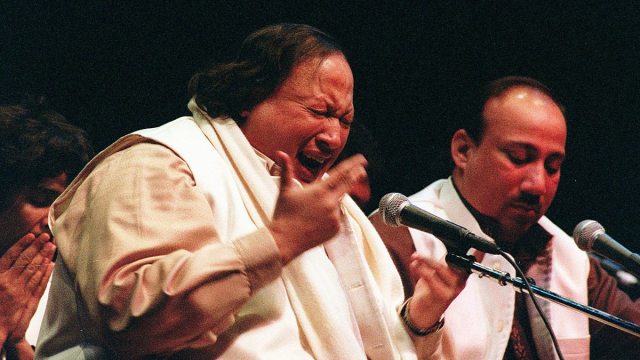
Nusrat Fateh Ali Khan is widely credited for bringing global attention to Qawwali music, extending the 600yr old Qawwali tradition of his family. By the time of his death following a heart attack, aged 48, in London, Nusrat was a legend in the artform.

The Asian Network is marking the anniversary of the death of Nusrat Fateh Ali Khan

This month sees the 20 year anniversary of his passing and we’re celebrating his work, and Qawwali music, on the Asian Network. But if you’re not quite up to speed with this potentially euphoric musical tradition, we’ve got a beginner’s guide to get you started.

What is Qawwali?

“Qawaali music,” explains Bobby Friction, “Is the physical and musical manifestation of the Sufi religious tradition in South Asia. Powerful, poetic & transcendent, its hypnotic rhythms and melodies celebrate God, love and music as one.

Qawaali emerged in what is now India and Pakistan in the 13th century, in close association with the Sufi and their Islamic mysticism. Typically, there are a lot of people involved in a performance, with eight or nine players making music with harmoniums, tabla, dholak and other percussive instruments. There was a time when women were banned from performing Qawwali music, but things have changed.

A lead vocalist and a small team of side singers take turns weaving in several different melodies, some of which will be improvised. After a long, improvised introduction for the main song, the singers all join in and vie with each other as the song builds towards its crescendo and sudden, abrupt end.

It’s all about the build-up, so Qawwali songs are rarely short – there are no radio edits here. They can be anywhere between 15 and 30 minutes long, with one of the longest known Qawwali songs – Hashr Ke Roz Yeh Poochhunga by Aziz Mian Qawwal – being almost two hours long!

What are the religious roots of Qawwali?

Qawwali has a deeply religious history dating right back to the 13th century. It is the music of Sufi-sm, also known as ‘Islamic mysticism,’ whose followers believe in learning from teachers, rather than relying on texts. The influence of Sufism is huge within Islamic literature, music and the wider artistic beyond Qawwali music was originally performed at Sufi shrines, and traditionally as part of a ‘mehfil-e sama’, a gathering for spiritual listening which often takes place on the anniversary of the death of shrine’s saint. It is still very religious music today.

What happens when people listen to Qawwali?

If you’re at a Qawwali performance, you could be in for quite the experience,

Qawwali music is performed with the intention of bringing listeners to a state of religious ecstasy and is known to hypnotize both performers and listeners.

The reaction to Qawwali is intended to bring everyone involved to a spiritual union with God. If you get the chance to see a performance it can be an intense and profoundly moving experience, no matter your personal faith.

How has Qawwali evolved over the centuries?

Qawwali music has moved with the times. Women are now welcomed both to perform and watch it, which they weren’t for a very long time.

It has also become really popular all over the world. Qawwali music was only really known in South Asia until the late 20th century, but after world music artists began working elements of Qawwali into their work, things went global.

Nusrat Fateh Ali Khan appeared on Peter Gabriel’s The Last Temptation of Christ soundtrack in 1988, and released six albums on Real World records. He recorded hundreds more (although some were never released commercially) during his career.

Qawwali musicians were given exposure in the UK with performances at WOMAD festival and supported by Peter Gabriel’s record label, Real World, during the early nineties.

Who are the important names in Qawwali you need to know?

OK, so Nusrat Fateh Ali Khan is a hugely important Qawwali musician, but who else should we be listening to?

The Sabri Brothers are also a leading force in the Qawwali music industry. They performed together for 60 years, between 1956 and 2016, released 53 albums during their career and their music is definitely worth checking out.

And it’s not just India that has produced the big names of Qawwali, Pakistan has a history of stars as well. Amjad Farid Sabri was one of the biggest Qawwali musicians from Pakistan and became one of the genre’s most acclaimed stars. Sadly, he was shot dead in Karachi by militants.

Nusrat Fateh Ali Khan’s legacy has been continued by his nephew Rahat Fateh Ali Khan, who is currently one of the biggest names in Qawwali music. He was trained by his uncle from the age of seven and has contributed music to many Bollywood and Hollywood movies during his career. He even worked as a judge on TV talent show Chhote Ustaad in India.

The Nooran Sisters (Jyoti and Sultana) are two of the best known female stars of the genre. They came to fame on MTV India’s talent show Sound Trippin and have sung in a string of Bollywood films.
Source: BBC – A beginner’s guide to Qawwali music

Posted in News | Comments Off on BBC – A beginner’s guide to Qawwali music

Khutba 2017 08 18 – Zikr of the Heart

bismillah-circle

The text of the khutba is available as a PDF file. Please go to zikr of the heart to download the file.

Posted in Khutbas | Leave a comment

Discostan’s Founder Followed Her Love of Sufi Spiritual Music All the Way to Pakistan

Arshida Fatima Haq records the alghoza player Jai Raam in Pakistan

Arshia Fatima Faq’s album of field recordings, “Ishq Ke Maare: Sufi Songs From Sindh and Punjab, Pakistan,” captures a style of music the Taliban is trying to wipe out.


Source: Discostan’s Founder Followed Her Love of Sufi Spiritual Music All the Way to Pakistan

Posted in News | Comments Off on Discostan’s Founder Followed Her Love of Sufi Spiritual Music All the Way to Pakistan

Sufism provides platform for interaction between East, West

With Muslims being portrayed as terrorists in the West, giving rise to Islamophobia, drawing a corresponding response from the East, Sufism provides a platform for the two sides to interact.

This was stated by Marcia Hermensen, a professor at the Loyola University in Chicago while delivering a lecture on “Sufism and the West”. The lecture had been organized by the Muslim Institute.

Exploring the mysticism of Sindh’s Sufis

Hermensen said that Sufism, practiced for centuries, made co-existence among various religions and civilizations possible in the past.

Moreover, she said that Sufism was often characterized as culture-friendly so that Islamic thought could be introduced through subjects such as art and poetry and hence Islam could spread around the world by meeting people where they were in their cultural interest in an adaptive manner.

In the wake of globalization, migration from ‘East’ to ‘West’ increased along with the invention of different modes of transportation, allowing more and more western population to come into contact with Sufism and also led to the establishment of Sufism in the West as an academic field. “The isolation of individuals has lead people to search for inner peace in Sufi poetry which can thus create a peace-loving and friendly society. Sufism provides the western community with rationality and objectivity regarding contemporary issues,” Hermensen said.

“Multiculturalism has emerged as a reality and Sufism provides us with the platform of interaction between the East and the West.”

One peculiarity of Sufi teachings, she said, was that it addresses humanity above all linguistic, racial and ethnic differences.

Celebrating Sufism and promoting the message of peace

“In the wake of prevailing extreme tendencies, Sufi teachings can lead us towards harmony and brotherhood,” she said, adding that focusing the commonalities and bridging the gap between people was the need of the hour.

With the portrayal of Muslims as extremists in the west giving rise to Islamophobia, drawing corresponding reactions in the East. there was a need for dialogue between Muslims and the West for the resolution of contemporary issues. “We are all connected to Sufism because of our spiritual aspect. Even scientists are looking for spiritual connections behind physical happenings,” she said.

Published in The Express Tribune, July 19th, 2017.


Source: Sufism provides platform for interaction between East, West

Posted in News | Comments Off on Sufism provides platform for interaction between East, West

Sufi shrines in China

New York-based artist visits enduring symbols of collective memory and faith in desert environment in northwest China

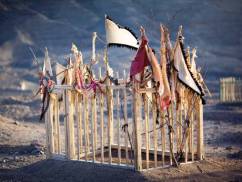
Photographer Lisa Ross is interested in exploring the liminal spaces where faith, culture and abstraction meet. In her latest exhibition in Dubai, Living Shrines, she is presenting a series of photographs of Sufi shrines in the Taklamakan desert in China, built by Uighur Muslim pilgrims. Between 2002 and 2012, the New York-based artist made several trips to the remote Xinjiang Uighur Autonomous Province in the far northwest of China to document these shrines that stand as poignant and enduring symbols of collective memory and faith in the harsh desert environment.

The shrines, known as mazars were built by the Uyghur people to commemorate Sufi saints, and many have been maintained continuously for several centuries. They are simple structures, comprising small crib-like wooden enclosures, or just a few sticks and stones arranged in the sand. But their importance in Uighur culture is indicated by the many offerings left behind by pilgrims, such as prayer flags, colourful silk fabrics, sacrificial animals, and dolls.

Ross’s ethereal photographs capture the beauty and tranquility of the desert landscape, and the simplicity and spirituality of the shrines. The tiny handmade structures appear so vulnerable, yet resilient; grounded yet otherworldly; ordinary yet extraordinarily beautiful.

There are no people in the pictures, but their presence is palpable in the fluttering flags, the carefully cut pieces of fabric, and other offerings they have left behind, and their footprints in the sand. The images convey Ross’s intimate knowledge of the culture, and her love for the land and people, but they also go beyond that to give viewers a sense of experiencing the pilgrimage, and the spiritual transcendence it signifies.

“I began this project at a time when I was really drawn to deserts. I had been working in the Sahara and Sinai deserts before a friend invited me to Beijing. I had never heard of the Uighurs or the Taklamakan desert, but when I read about the Xinjiang Uighur Autonomous Province in a travel guide in Beijing, I intuitively felt like going to this remote region. It involved a train journey of three and a half days, and then finding a rental car and a driver to take me deeper into the desert.

“When I saw these shrines for the first time, in the rugged, desolate desert I had no idea what they were. I was curious to learn more about them,” Ross says.

Over the next decade, she travelled to the area many times – on her own, as well as with people who know the region such as French historian Alexandre Papas and Uighur folklorist Rahile Dawut, who helped her to connect with the community and get a deeper understanding of the land and its history. In 2013, Ross published a book, Living Shrines of Uyghur China, which features her photographs of the mazars, and background texts by Papas and Dawut.

“When I travelled with Papas in 2004, we found a pilgrim’s guide book in the Uighur language giving information about the location and history of 86 mazars. Using this guide, we visited over 25 mazars, travelling by foot, donkey cart, bicycle, minivan, taxi, train and bus.

“The people we met were always friendly and helpful, and each journey was a unique pilgrimage. Later, I met Dawut, the author of that guide, at a conference on Uighur culture at the School of Oriental and African studies in London, and she was amazed that her book had been used by two foreigners. She invited me to travel across the region again with her, and in 2005, we travelled together in the area for six weeks. Being with her was like moving from the outside to the inside. Even though we visited remote mazars, she had family and friends everywhere, who welcomed us warmly. The entire experience created a greater desire to return and continue developing the project,” Ross says.

Her photographs become more significant in the context of the changes that are taking place in the region. With the development and modernisation policies of the Chinese government threatening to turn these living shrines into relics of the past, Ross’s images are an important record of a rich and vibrant culture on the threshold of change.

“While working on this project, I made a conscious decision to remain apolitical. Through my photographs I want to convey my personal experience of this region and culture, and also give viewers the same moving, emotional experience that I had when I saw the shrines,” Ross says.

Jyoti Kalsi is an arts enthusiast based in Dubai

Living Shrines will run at Gulf Photo Plus, Al Serkal Avenue, Al Quoz until September 2.

Source: Sufi shrines in China

Posted in News | Leave a comment